Article: Fluorite Colors and Varieties: Rainbow, Illinois, and Elmwood
Fluorite Colors and Varieties: Rainbow, Illinois, and Elmwood
A green-and-purple palm stone and a sharply formed cube from an American mine can look like completely different kinds of collectible. Both can be fluorite. The difference is what catches your eye: bands revealed by polishing, natural crystal faces, or a specimen's connection to a particular place.
This guide brings those interests together. We'll look at fluorite colors and names such as rainbow, candy, and snowflake, then explore collector specimens from Illinois and the Elmwood Mine in Tennessee. You don't have to choose between polished stones and natural crystals to enjoy both.

What is fluorite?
Fluorite is calcium fluoride, with the chemical formula CaF2. It occurs in colors including purple, green, yellow, blue, pink, and colorless. Natural crystals often form cubes; octahedra and combinations of crystal forms also occur. A polished tower or palm stone, by contrast, has been shaped by people rather than growing in that finished form.
Fluorite has a Mohs hardness of 4 and pronounced cleavage: it can split along particular planes in its crystal structure. That makes careful handling important, whether you're choosing a small tumble or a cabinet specimen. The Natural History Museum of Utah's fluorite guide shows examples of its crystal forms, color variations, and cleavage.
Some fluorite fluoresces under ultraviolet light, but don't assume that every piece will glow. Fluorescence is a separate feature from the bands visible in ordinary light; a name like “rainbow fluorite” doesn't promise a UV effect.
Fluorite colors: rainbow, candy, watermelon, and snowflake
Bands or regions of different color within fluorite are called color zones. They can record successive stages of crystal growth. Polishing can make those internal patterns easier to view. Other minerals can also create contrasts within a specimen, so not every pale patch or colored feature is part of the fluorite itself.
It helps to separate three kinds of description: color tells you what a piece looks like, a trade name describes how it is marketed, and a locality records where it was found. They answer different questions.
Rainbow fluorite
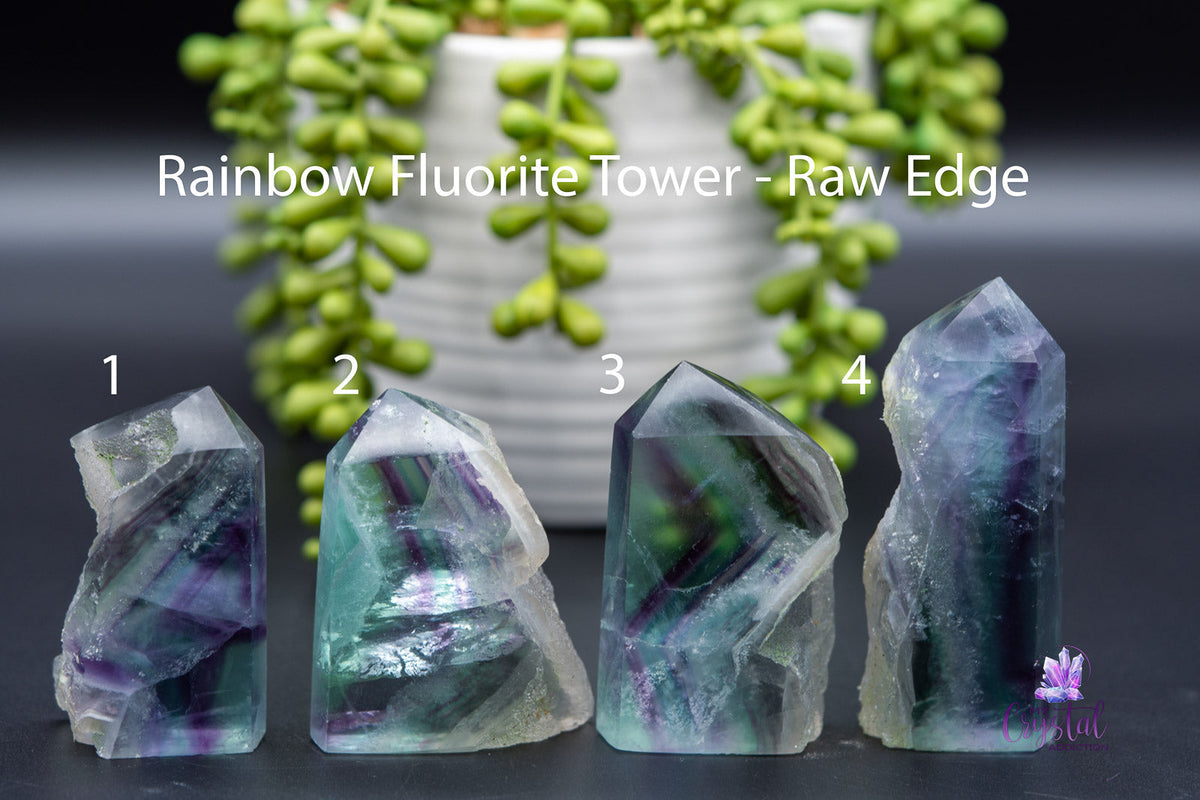
“Rainbow” describes multicolored fluorite, not a separate mineral species. Green and purple may appear beside pale or nearly colorless zones. Some pieces have narrow, distinct bands; others have broader areas of color. Compare the individual photographs rather than expecting every rainbow piece to contain the same colors.
Our green and purple fluorite tumbles and rainbow towers offer two ways to enjoy that contrast: a small rounded form or a taller display piece. For towers, look at the banding from more than one side as well as the shape of the base.
Candy and watermelon fluorite
Names such as “candy” and “watermelon” are trade descriptions, not separate mineral species, standardized grades, or documented origins. Rather than expecting a fixed color combination from a name, compare the photographs and description of the actual piece.
Our candy fluorite palm stones illustrate the variety: the examples below have different arrangements of green, purple, pale, and warm-toned areas. The rounded surfaces offer a different view of the bands from the flat faces of a tower.

Snowflake fluorite
In our snowflake fluorite towers, pale, cloudy patterns contrast with darker green and purple areas. “Snowflake” is a useful visual label, but it does not identify the pale material. We wouldn't name an inclusion mineral from its appearance alone.
The balance of pale and dark areas gives each tower a different look. Our snowflake tower listing is for one piece selected from the photographed group, rather than an individually numbered choice.

Collector fluorite: when the locality becomes part of the story
A natural crystal specimen offers something different from a polished piece: you can examine the faces that grew, how crystals meet one another, and how they sit on their host material, or matrix. A reliable locality label adds geological and collecting context.
Treat “collector grade” as a seller's description, not a substitute for a condition report. Ask what makes the particular specimen interesting: well-defined faces, attractive zoning, luster, transparency, associated minerals, or a documented collection history. A famous mine name alone doesn't establish quality or future value.
Illinois and Elmwood are two useful places to begin exploring locality-based collecting.
Illinois fluorite: color zoning and a historic mining district
Fluorite is Illinois' state mineral. The Illinois State Geological Survey describes the state's principal fluorspar deposits in Hardin and Pope Counties, within the Illinois–Kentucky Fluorspar Mining District. Rosiclare and Cave-in-Rock are important names in that history.
The specimen below is documented as coming from the Minerva No. 1 Mine, also called Mahoning No. 1, in Hardin County. Its yellow cores and purple outer zones make the internal color pattern visible within the stepped cubes. It is one example of Illinois fluorite, not a color template for everything from the district.

When comparing Illinois specimens, look at the faces and edges as closely as the color. Ask for photographs of the back and base, details of any repairs or restoration, and the original label if one survives. “Illinois” is a broad locality; an exact mine name is more informative when it is supported by the specimen's records.
Keep the label with the specimen. If a record gives only a district, retain that level of detail rather than assigning a more specific mine because the colors look familiar.
Elmwood fluorite: Tennessee crystals with a distinct collecting history
The Elmwood Mine is near Carthage in Smith County, Tennessee. The Lewis Elrod Elmwood Mine Collection describes the area's fluorite alongside calcite, sphalerite, and barite. Its account notes transparent to translucent fluorite in blue and purple shades.
The photographed example has two intergrown purple fluorite cubes with darker edges and finely stepped faces. Their partly transparent interiors and contrasting borders make the crystal shapes easy to follow. It is a different way to enjoy purple fluorite from the bands seen in a polished tower. Not every Elmwood piece has the same color, clarity, or crystal arrangement.

For an Elmwood purchase, ask whether the locality is recorded on an original label or supported by a traceable seller or collection history. Examine exposed corners, contacts with the matrix, and any glued or repaired areas. A close-up and an ordinary-light photograph can tell you more about its display appearance than a dramatically lit image alone.
Illinois and Elmwood specimens are not competing grades of fluorite. They offer different examples to study. Choose the individual piece for its features, condition, documentation, and the way you want to display it—not simply the more impressive locality name.
How to choose a fluorite piece you'll enjoy
- Start with the form. A polished palm stone emphasizes its rounded shape and internal bands. A tower gives a vertical view of the pattern. A natural specimen lets you study crystal faces and their arrangement.
- Check scale. Use the stated measurements rather than judging size from a close-up or a hand in the photograph. Think about the shelf, stand, or display case where it will live.
- Understand condition. Ask about chips, scratches, fractures, repairs, coatings, and restoration. Natural growth features and later damage are different things, and a seller should help explain what is present.
- Match the picture to the purchase. Confirm whether you're choosing an exact photographed piece or receiving one from a group. On a multi-option listing, check which photograph and measurements belong to your selection.
- Separate facts from labels. A trade name, color, or photograph cannot verify an untreated stone or a mine locality. Ask for whatever documentation matters to your purchase.
A polished piece can be just as satisfying to collect as a natural crystal. You might build a small group around a favorite color, compare different forms, or gradually add documented localities. There is no need to buy the largest piece or treat the purchase as an investment.
Caring for and displaying fluorite
Fluorite's softness and cleavage make protection from scratches and knocks the priority. Keep pieces separated rather than loose in a bowl with harder stones. Use a stable base or a suitable stand, and support a matrix specimen from underneath rather than lifting it by a projecting crystal.
For routine dusting, start with a gentle approach such as a soft, clean brush, avoiding fragile projections. Don't scrub, scrape, or use scratch or chemical tests to try to authenticate a piece. A specimen with several minerals, old adhesive, or restoration may need different care from a simple polished stone; ask for specimen-specific cleaning advice before using liquids or equipment.
A sheltered shelf or display case is a sensible starting point. Avoid places where a piece could be knocked over or exposed to strong heat. The best display lets you enjoy the color and shape without putting the specimen at risk.
Explore fluorite at My Crystal Addiction
For polished pieces, browse our fluorite collection, including candy palm stones, rainbow raw-edge towers, and green-and-purple tumbles. You can also explore the snowflake fluorite tower listing for the pale-and-dark pattern shown above.
Whether you're drawn to a banded palm stone or a documented mine specimen, start with what you enjoy looking at. A well-chosen piece can open the door to noticing more: a new color zone, a sharply defined corner, or the way one crystal grew beside another.
Sources and photograph credits
- Natural History Museum of Utah: What is Fluorite? — crystal forms, color variations, fluorescence, and cleavage.
- Illinois State Geological Survey: Fluorite—Illinois' State Mineral — mineral properties and the history of the Illinois mining district.
- Lewis Elrod Elmwood Mine Collection: History of the Elmwood Mine — Tennessee locality, associated minerals, and collecting history.
- Illinois and Elmwood photographs: Rob Lavinsky, iRocks.com, via the linked Wikimedia Commons file records. Each photograph remains available under Creative Commons Attribution-ShareAlike 3.0. No endorsement is implied. The images have not been cropped or color-adjusted.
- Polished-product photographs: My Crystal Addiction. These illustrate the linked product ranges; consult each listing for current options.

Written by John Staggs