Types of Quartz Crystals: From Clear to Rare, Here’s Everything You Need to Know
Quartz is one of the most abundant minerals on Earth - and also one of the most varied. The same silicon dioxide (SiO₂) chemistry produces crystals that range from water-clear to black, from smooth microcrystalline masses to towering cathedral points. Understanding how quartz is classified makes it much easier to identify different varieties and choose the right stone for your collection.
Quartz falls into two structural families: macrocrystalline quartz, which includes clear quartz, amethyst, rose quartz, citrine, smoky quartz, and ametrine, and microcrystalline quartz (chalcedony), which includes agate, jasper, and carnelian. Differences in color, clarity, and pattern come from trace minerals, inclusions, and natural geological processes during formation.
This guide by My Crystal Addiction covers the major types of quartz crystals, how they form, how to identify them, and what to know before you buy.
The Two Structural Families of Quartz
All quartz is SiO₂, but geologists split it into two groups based on crystal size. This distinction matters practically: it explains why a piece of jasper and a clear quartz point look nothing alike despite being the same mineral.
Family |
Crystal Size |
Appearance |
Common Varieties |
Macrocrystalline |
Visible to naked eye |
Transparent to translucent, often pointed or clustered |
Clear quartz, amethyst, rose quartz, citrine, smoky quartz |
Microcrystalline (Chalcedony) |
Microscopic requires magnification |
Waxy, opaque or semi-opaque, often banded or patterned |
Agate, jasper, carnelian, onyx, chalcedony |
When most people say “quartz crystal,” they mean the macrocrystalline group. The chalcedony family is equally valid quartz just structurally different.
Macrocrystalline Quartz: Types, Appearance & Identification
These are the types of quartz most commonly found in crystal shops, geological collections, and jewelry. Each variety gets its distinct appearance from specific physical or chemical conditions during formation.
1. Clear Quartz (Rock Crystal)
What it looks like: Transparent and colorless, ranging from water-clear to slightly hazy. Often found as six-sided prismatic points with a pyramidal termination.
How it forms: Pure SiO₂ with no significant trace minerals. The clearest specimens form in pegmatite veins or hydrothermal environments where iron and other impurities are absent.
How to identify it: Glass-like clarity, cool to the touch (real quartz stays cooler longer than glass), and a hardness of 7 on the Mohs scale and will scratch glass easily.
Common forms: Single points, clusters, tumbled stones, spheres, raw chunks. Arkansas and Brazil are major sources.
Watch out for: Clear glass sold as quartz. Glass warms in your hand faster, often has bubbles, and won’t scratch a steel knife blade.

2. Rose Quartz
What it looks like: Pale to medium pink, typically translucent rather than transparent. Rarely forms distinct crystal points usually found as massive (non-crystalline) chunks or tumbled stones. Occasional specimens show asterism (a star pattern) when cut as cabochons.
How it forms: The pink color comes from microscopic inclusions of a pink borosilicate mineral (dumortierite or a related fiber), not from iron as was previously thought. This fibrous inclusion also explains its typical translucency and lack of distinct crystal faces.
How to identify it: Soft pink color, milky translucency, almost never forms clean crystal points. The color is evenly distributed, not zoned or banded.
Common forms: Raw chunks, tumbled stones, spheres, carvings. Brazil and Madagascar are primary sources.
Watch out for: Dyed quartz or glass sold as rose quartz. Authentic rose quartz has an even, somewhat muted pink not a saturated or neon hue.

3. Amethyst
Amethyst crystal looks like: Purple, ranging from pale lavender to deep violet. Transparent to translucent. Typically forms as six-sided prisms. Often found as geodes (hollow rock cavities lined with crystal points) or clusters.
How it forms: The purple color comes from iron impurities (Fe³⁺) combined with natural irradiation. The same iron without irradiation produces colorless or yellow quartz which is why heat-treating amethyst turns it orange-yellow (citrine).
How to identify it: Purple color, hexagonal crystal shape, color often more concentrated at tips than base (called color zoning). Genuine amethyst may show slight color variation under different lighting.
Common forms: Geodes, clusters, points, tumbled stones, raw pieces. Uruguay and Brazil produce the deepest colors; Zambia produces finer, more saturated material.
Watch out for: Synthetic amethyst (lab-grown) is chemically identical but too perfect. Unusually deep, perfectly uniform color at a very low price warrants closer inspection.
See also:Uses for Amethyst Crystals: Beyond Basic Meditation

4. Citrine
What it looks like: Yellow to orange-yellow, transparent. Natural citrine is typically pale yellow. The saturated orange-amber material commonly sold as citrine crystal is almost always heat-treated amethyst.
How it forms: Natural citrine gets its color from trace iron in a specific oxidation state (Fe³⁺ at lower concentrations than in amethyst). Heat-treated citrine is produced commercially by heating amethyst to around 470–750°C, which shifts the iron’s oxidation state and changes the color from purple to yellow-orange.
How to identify natural vs. treated citrine: Natural citrine is pale lemon-yellow to golden, often with a slight greenish tint, and color is evenly distributed. Heat-treated citrine tends to be a stronger orange or reddish-orange with white, milky base with the color zone concentrated at the tip and the base remaining pale or whitish.
Common forms: Points (often cathedral-shaped with that distinctive white base), clusters, tumbled stones.
Bottom line: Heat-treated citrine is not fraudulent - it’s a standard practice, widely disclosed. The key is that sellers should tell you which type you’re buying.

5. Smoky Quartz
What it looks like: Brown to dark grey-black, transparent to nearly opaque. One of the few naturally dark quartz varieties that still maintains transparency in lighter specimens.
How it forms: Color caused by natural irradiation (from radioactive elements in surrounding rock) acting on aluminum impurities within the crystal lattice. This creates color centers that absorb light, producing the brown-grey tones. The same process can be replicated artificially as described below.
How to identify natural vs. irradiated smoky quartz: Natural smoky quartz has gradual color gradients and uneven distribution. Artificially irradiated material tends toward jet-black and unnaturally uniform color - sometimes called “black quartz” and sold as such.
Common forms: Points, clusters, raw chunks, tumbled stones. Scottish cairngorm is a prized natural variety; Brazil and Colorado produce excellent specimens.
6. Aventurine
Aventurine crystal: Typically green, with a distinctive glittery or shimmering effect called aventurescence. Also occurs in blue, red-brown, orange, and grey varieties. Usually opaque to translucent.
How it forms: The shimmer comes from flat, reflective mineral inclusions within the quartz typically fuchsite (a chromium-rich mica) for green aventurine, or hematite/goethite for red-brown varieties. The inclusions are large enough to reflect light individually, creating that characteristic sparkle.
How to identify it: The aventurescence (internal sparkle) distinguishes it from other green stones. Unlike malachite or jade, aventurine has that distinct glitter when rotated under light.
Common forms: Tumbled stones, carvings, cabochons, raw chunks. India is a major source of green aventurine.

7. Ametrine
Ametrine crystal: A single crystal showing both purple (amethyst) and yellow-orange (citrine) zones, often split roughly 50/50 across the crystal.
How it forms: Temperature variations during crystal growth cause different oxidation states of iron within the same crystal with one zone forming under conditions that produce amethyst color, the adjacent zone under conditions that produce citrine color. Natural ametrine forms almost exclusively at the Anahí mine in Bolivia.
How to identify it: The sharp or gradual color boundary between purple and yellow within one crystal is the defining feature. Synthetic ametrine exists it will show identical color zoning but may be suspiciously inexpensive or too geometrically perfect.

8. Milky Quartz
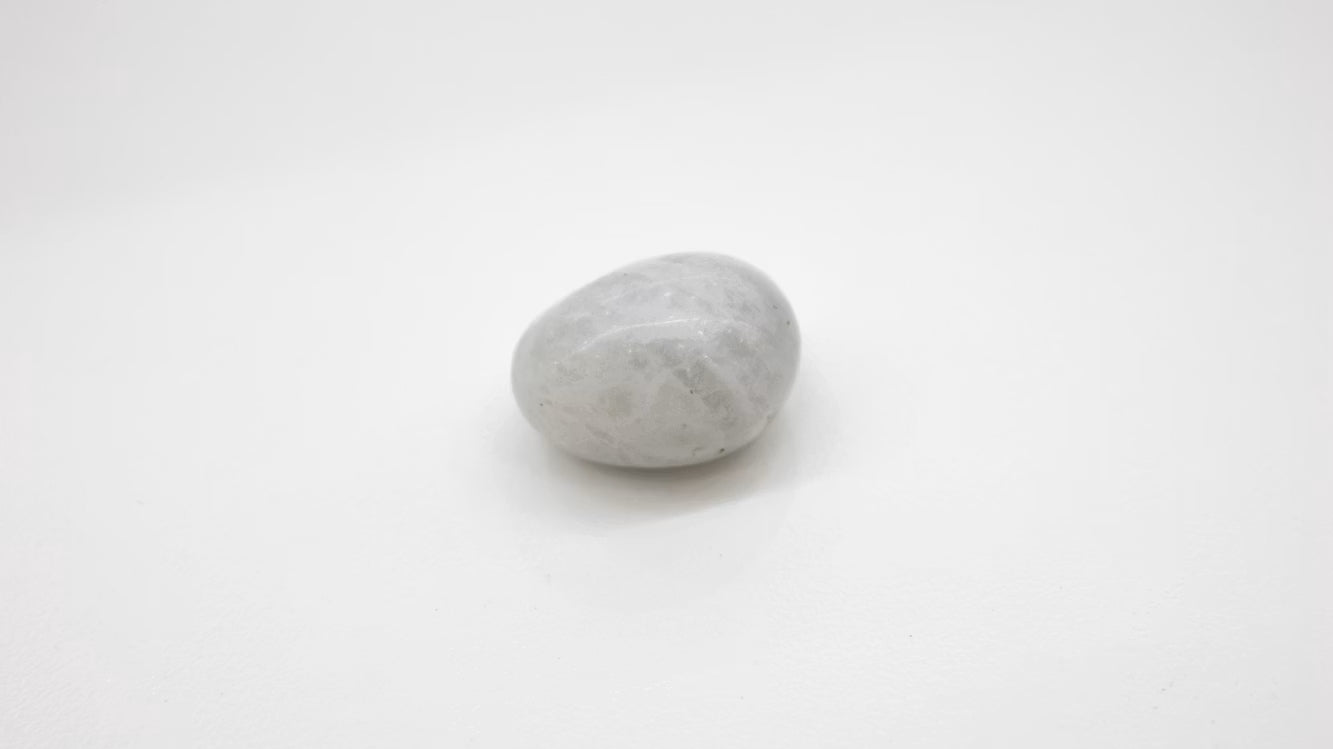
What it looks like: White to cream-colored, opaque to translucent. Often found in large masses rather than distinct crystals.
How it forms: The cloudiness comes from numerous tiny fluid or gas inclusions trapped during crystal growth. These scatter light, producing the white, non-transparent appearance. It is the most common variety of quartz in the Earth’s crust.
How to identify it: White color with waxy or cloudy texture. Harder than calcite (won’t react to acid) and harder than glass.
Rare & Collector Quartz Varieties
Beyond the common types of quartz crystals, a number of quartz formations are prized by collectors for their unusual physical characteristics. These are rarer, often more expensive, and identified by specific structural features rather than just color.
Variety |
Identifying Feature |
How It Forms |
Rutilated Quartz |
Golden, silver, or copper needle-like inclusions running through clear or smoky quartz |
Rutile (titanium dioxide) crystals grew first; quartz grew around them |
Phantom Quartz |
Ghost-like outline of an earlier crystal stage visible inside the current crystal |
Crystal paused growth, accumulated mineral dust on surface, then resumed growing |
Elestial Quartz |
Layered, etched, or skeletal surface with multiple terminations |
Rapid crystal growth from multiple points simultaneously |
Faden Quartz |
White thread or line running through the interior of a tabular crystal |
Crystal fractured during growth and rehealed, leaving a visible seam |
Enhydro Quartz |
Trapped fluid visible as a movable bubble inside the crystal |
Liquid was sealed inside the crystal during formation, sometimes millions of years ago |
Tourmalinated Quartz |
Black tourmaline needles inside clear quartz (distinct from rutile, which is golden) |
Tourmaline grew first in a pegmatite; quartz later encased it |
Microcrystalline Quartz: The Chalcedony Family
Most of the types of quartz crystals commonly sold in crystal shops belong to the macrocrystalline family. Chalcedony varieties don’t look like what most people picture when they think “quartz crystal.” But chemically and mineralogically, they are quartz but with crystals too small to see individually, which gives them their distinctive waxy, smooth appearance.
Variety |
Color / Appearance |
Key Identifying Feature |
Agate |
Multicolor, banded |
Concentric or parallel banding; translucent layers |
Jasper |
Red, yellow, brown, green : opaque |
Fully opaque; color from iron oxides and clay minerals |
Carnelian |
Orange to red-orange |
Translucent orange; smooth waxy luster; no banding (vs. agate) |
Onyx |
Black, or black-and-white banded |
Parallel bands (not concentric like agate); dense, fully opaque |
Chrysoprase |
Apple green |
Its color comes from nickel, not copper; one of the rarest chalcedonies |
Bloodstone |
Dark green with red spots |
Green jasper with red hematite inclusions |
A practical tip for telling chalcedony varieties apart: agate is banded and translucent; jasper is opaque with no banding; carnelian is translucent orange without bands. Onyx is the banded black variety.
All Types of Quartz: Full Comparison Table
A side-by-side reference covering color, identifying features, hardness notes, and typical forms found in the market.
Type |
Color |
Transparency |
Key ID Feature |
Common Form |
Clear Quartz |
Colorless |
Transparent |
Water-clear, cool to touch, scratches glass |
Points, clusters, spheres |
Rose Quartz |
Pale–medium pink |
Translucent |
Milky pink, rarely forms points, evenly colored |
Tumbled, raw, carvings |
Amethyst |
Lavender to deep purple |
Transparent–translucent |
Hexagonal points, color zoning at tips |
Geodes, clusters, points |
Citrine (natural) |
Pale lemon yellow |
Transparent |
Even pale yellow, no white base |
Points, clusters |
Citrine (treated) |
Orange to reddish-orange |
Transparent |
White base, color concentrated at tip |
Cathedral points |
Smoky Quartz |
Brown to near-black |
Transparent–opaque |
Gradual brown gradient, hexagonal form |
Points, raw, tumbled |
Aventurine |
Green (+ other colors) |
Translucent–opaque |
Internal glitter (aventurescence) |
Tumbled, carvings |
Ametrine |
Purple + yellow in one |
Transparent |
Two distinct color zones in one crystal |
Points, faceted gems |
Milky Quartz |
White to cream |
Opaque |
Cloudy white, no color |
Raw masses |
Rutilated Quartz |
Clear + gold/silver threads |
Transparent |
Needle-like inclusions inside |
Tumbled, cabochons |
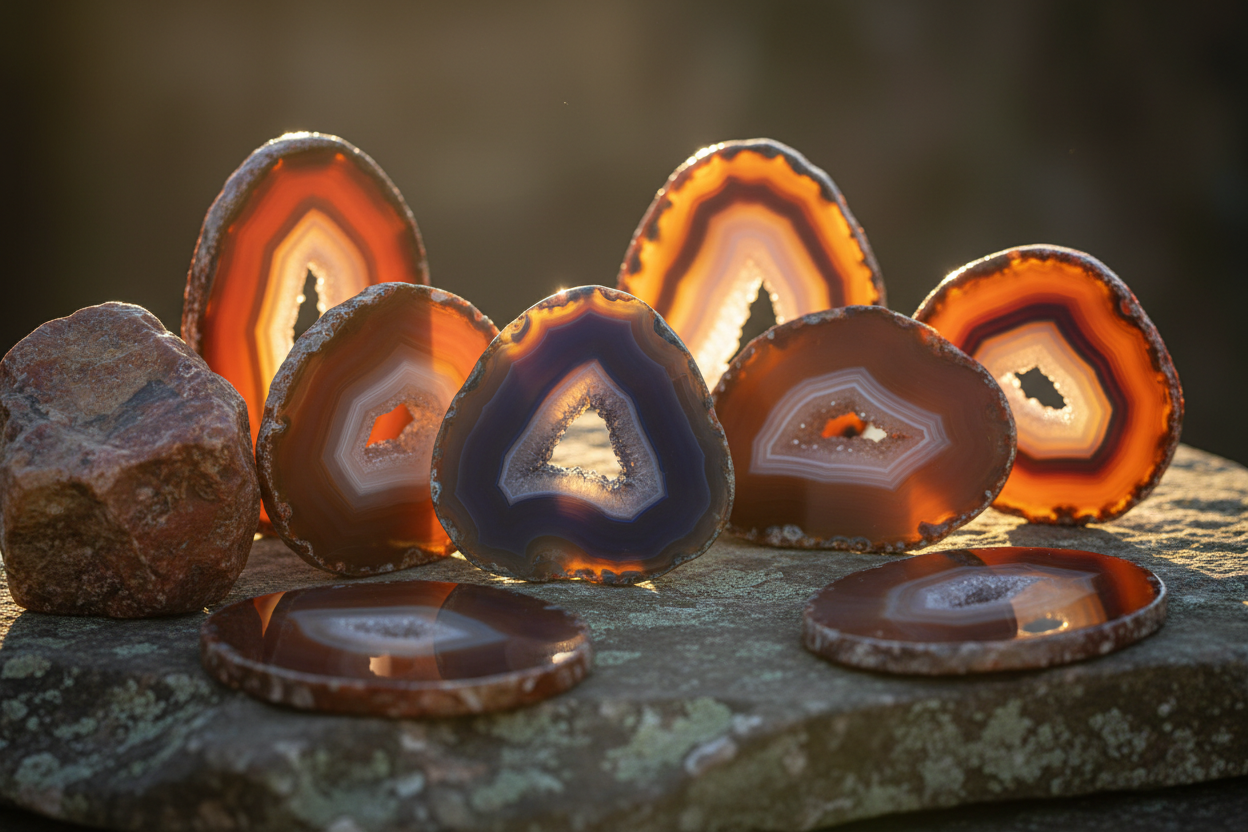
Agate |
Multicolor, banded |
Translucent |
Concentric banding |
Slabs, tumbled, nodules |
Jasper |
Red, brown, yellow, green |
Opaque |
Fully opaque, no pattern required |
Tumbled, carvings |
Carnelian |
Orange to red-orange |
Translucent |
Warm orange, no banding, waxy luster |
Tumbled, beads |
How to Identify What Type of Quartz You Have
If you’ve picked up a piece and aren’t sure what it is, work through these questions:
- Is it transparent, translucent, or opaque? Transparent → macrocrystalline group (clear quartz, amethyst, citrine, smoky). Opaque or waxy → likely chalcedony (jasper, agate, carnelian) or milky quartz.
- What color is it? Purple = amethyst. Pink = rose quartz. Yellow-orange = citrine (natural or treated). Brown-grey = smoky quartz. Green with sparkle = aventurine. White/cloudy = milky quartz. Colorless = clear quartz.
- Does it have a pattern? Concentric bands = agate. No pattern, fully opaque = jasper. Orange, no bands = carnelian.
- Are there inclusions? Golden or silver needles inside clear quartz = rutilated quartz. Black needles = tourmalinated quartz. A ghost outline inside = phantom quartz. A movable bubble = enhydro quartz.
- Does it have a visible crystal structure? Six-sided prism with a pointed top = classic macrocrystalline quartz. No visible crystal faces = chalcedony or massive quartz.
Still unsure? Our crystal meanings guide covers additional identification details for common stones.
What to Know Before You Buy: Natural, Treated & Synthetic Quartz
Understanding treatment and authenticity helps you buy confidently and ask the right questions.
Common Treatments in the Quartz Market
Treatment |
Affects Which Type |
How to Spot It |
Heat treatment |
Amethyst → citrine color |
Deep orange color + white base on citrine; natural citrine is pale yellow |
Artificial irradiation |
Clear quartz → smoky color |
Jet-black, unnaturally uniform “smoky” quartz; natural is brown-grey with gradients |
Dyeing |
Agate, chalcedony |
Unnaturally vivid colors (electric blue, hot pink); color concentrated in cracks |
Glass infilling |
Cracked stones |
Unusual clarity in specific cracks; lower density than solid quartz |
Natural vs. Synthetic Quartz
Lab-grown quartz (hydrothermal synthetic) is chemically identical to natural quartz and used widely in electronics and jewelry. For collectors, the distinction matters:
- Natural: Contains inclusions, growth zones, minor irregularities signs of geological time
- Synthetic: Unusually perfect clarity, no inclusions, very consistent color, sometimes a slightly different refractive index under gemological testing
- Imitation (glass): Not quartz at all warms faster in hand, lower hardness, often contains bubbles, won’t scratch glass
- For care and cleansing by quartz type, see ourcomplete guide to cleansing crystals.
Frequently Asked Questions
Explore answers to frequently asked questions about the different types of quartz crystals.
What are the different types of quartz crystals?
The main macrocrystalline types are clear quartz, rose quartz, amethyst, citrine, smoky quartz, aventurine, ametrine, and milky quartz. The microcrystalline (chalcedony) family includes agate, jasper, carnelian, onyx, and chrysoprase. Rare collector varieties include rutilated, phantom, elestial, faden, and enhydro quartz.
How many types of quartz are there?
Mineralogists recognize over 40 named quartz varieties when you include all chalcedony subtypes and named formations. Most crystal guides cover the 10–15 varieties most commonly found on the market.
Is amethyst a type of quartz?
Yes. Amethyst is a macrocrystalline quartz variety. Its purple color is caused by iron impurities (Fe³⁺) combined with natural irradiation during formation. Heat-treating amethyst removes the color, producing citrine.
What is the difference between quartz types?
Color and appearance differences between quartz types come from trace minerals present during formation (iron produces purple in amethyst, pink in rose quartz), natural irradiation (smoky quartz, amethyst), inclusions (aventurine’s shimmer from mica, rutilated quartz’s needles), or structural differences in crystal growth (macrocrystalline vs. chalcedony).
What is the rarest type of quartz?
Among collector varieties, enhydro quartz (containing trapped ancient fluid) and natural ametrine from Bolivia’s Anahí mine are considered among the rarest. Fine phantom quartz with clearly defined inclusions and large, undamaged elestial specimens are also uncommon.
What’s the difference between natural and heat-treated citrine?
Natural citrine is pale lemon-yellow with an even color distribution. Heat-treated citrine (heated amethyst) tends to be a deeper orange or reddish-orange with a white or milky base and color concentrated toward the crystal tip. Both are sold legitimately - the key is knowing which you’re buying.
Can quartz scratch glass?
Yes. All quartz varieties have a Mohs hardness of 7, which means they will scratch glass (hardness ~5.5) and most steel knives (~6.5). This is a useful field test to distinguish quartz from softer lookalikes like calcite (hardness 3) or fluorite (hardness 4).
What’s the difference between agate and jasper?
Both are chalcedony (microcrystalline quartz), but agate is translucent and typically banded, while jasper is fully opaque and usually shows no banding. If you can see light through a thin edge, it’s more likely agate than jasper.
Is aventurine always green?
No. Green is the most common color, but aventurine also occurs in blue, red-brown, orange, grey, and yellow. The defining feature is aventurescence - the internal sparkle caused by reflective mineral inclusions - not the color.
Wrapping Up
Quartz is a remarkably diverse mineral family. The same SiO₂ chemistry produces everything from water-clear points to jet-black smoky specimens, from softly pink massive rose quartz to phantoms containing the ghost of an earlier crystal life. Knowing what physically distinguishes each variety and knowing what to watch for when buying - is what separates an informed collector from someone simply going by looks.
If you’re ready to start or expand your collection, browse our hand-selectedquartz crystals at My Crystal Addiction - or use the “Find the Quartz That’s Right for You” table above to go straight to the variety that fits what you’re looking for.
%20chemistry%20produces%20crystals%20that%20range%20from%20water-clear%20to%20black,%20from%20smooth...)